
Talking ‘The Cola Pop Creemees: Opening Act’ With Desmond Reed
by Rachel Bellwoar
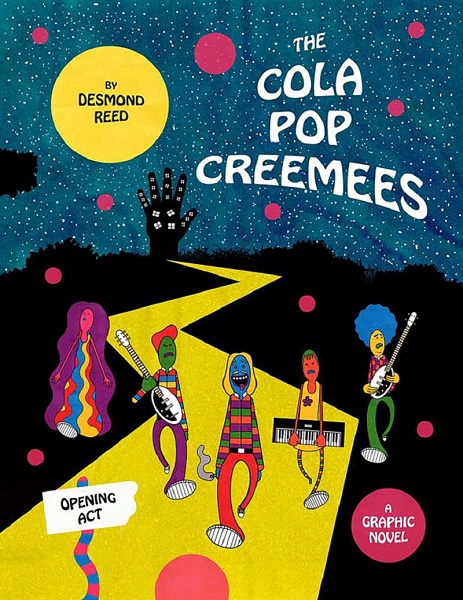
Sure, the Beatles had a yellow submarine but did they all live together in a hand-shaped house? The Cola Pop Creemies do in Desmond Reed’s new graphic novel, The Cola Pop Creemees: Opening Act, about a fictional band with a lot of baggage. Available this April, it was a dream to be able to ask Reed some questions over email. For more on the agony of creating a set list and an alternate scene from the story, “Dear Diary,” check out Reed’s interview below:

Rachel Bellwoar: This isn’t the first time you’ve returned to the characters of the Cola Pop Creemees but I believe (and please correct me if I’m wrong) this is the first book you’ve put out about them. When putting this collection together, was the goal to collect other Cola Pop Creemees stories you’ve done in the past or did you always want to do a mix of old and new material?
Desmond Reed: You are correct! I created these characters years ago, but didn’t really know what to do with them until the pandemic hit. With the whole world paused, I decided to write, draw, and post a page to Instagram every day to pass the time. The characters and stories started developing as a web comic, and after about a year, I redrew the best stories and The Cola Pop Creemees: Opening Act was born! Opening Act is indeed the first Cola Pop Creemees graphic novel, but there are a bunch of Cola Pop Creemees mini-comics in the world as well, including Lefty, which was published by Birdcage Bottom Books last year.

RB: Besides being entrancing (in all its psychedelic glory), what’s amazing about the cover image you’ve created is how economical it is, in terms of getting across who each member of the Cola Pop Creemees is by their facial expression. Was it an easy choice to make or did you go through a lot of alternatives?
DR: Thank you very much! When I first pitched the Opening Act to publishers, it had a completely different cover! I had the unbelievable good fortune of Birdcage Bottom Books agreeing to publish the book and linking up with Microcosm Publishing for distribution. It was at that point that we started talking about revisiting the cover. I’ve never done any kind of book design before, so I dedicated an entire week to creating the best introductory image that I could, and I couldn’t be happier with the end result.
RB: In the same way that a band might spend a lot of time curating the perfect set list, did it take a while to figure out what order you wanted to put the stories in?
DR: THANK YOU SO MUCH FOR ASKING THIS – YES!!! Creating the perfect setlist drove me insane and I feel like nobody understood the agony until now!!! Certain stories were locked into their spots, but I switched around the others for months. The early promo version of the book actually had a much different order, with ‘Dear Diary‘ broken up into little interludes between the other stories. I’m very happy with where everything is placed now, and don’t know why the process was as painful as it was! I blame myself!

RB: One idea that gets explored across multiple stories is the influence parents have over their kids, and not in a good way —at one point the parents look like parasites from a sci-fi movie, hanging onto their kids. What about that image rang true to you?
DR: You know, that image comes up a lot – it’s cool to know that it’s resonating! The story it’s from (Pilot) is about the way we impact the people in our lives, whether we mean to or not. I sometimes consider the advice I BELIEVE friends and family would give me when making decisions. It’s kind of a subconscious experience, but I can imagine their voice and even the cadence in which they’d tell me what to do! I wanted to visually represent what it feels like to be “piloted” in this way, and the parasite/possession avenue felt right… unless THAT decision was just a product of the imagined advice of others too… oh no!
RB: I also love the way that you draw attention to the little things (like that moment when you first wake up, and haven’t yet remembered the events of the previous day, or that specific anxiety of realizing your friend hasn’t responded to a text that they definitely saw). They’re experiences that are so universal, yet not always named or talked about, and I was wondering how you go about collecting your ideas. Do you immediately start drawing when inspiration strikes, or are these observations you’ve been holding onto for a while?
DR: I appreciate you saying that! Most of my ideas for stories start with small moments, like the ones you mentioned, and work into bigger narratives. For example, the story I’m currently posting to Instagram started with the memory of looking at the back of my friend’s head as they walked by, and how that actually ended up being the last time I ever saw them. I don’t really write anything down until I start on the actual page, but I have a lot of things bouncing around in my brain at all times, which is great for writing but a terrible way to live!

RB: In ‘Talent’, we get to see some of the comics that tambourine player, Mona, has been cooking up. Is it fun to draw and write comics as another character?
DR: Believe it or not, those are actually MY old comics from like 15 years ago! I just redid them for the book and blamed them on Mona Gertrude. I’m happy that I was able to repurpose them instead of letting them die in a dusty pile under my bed!
RB: ‘Dear Diary’ offers readers a chance to see what the Cola Pop Creemees were like as children yet (true to the story’s title) they’re memories that feel very private and like they wouldn’t be the ones the Creemees would necessarily share about themselves. How did you decide which memories to single out?
DR: ‘Dear Diary’ was really fun to write and I remember it was the second to last story I finished for Opening Act. I felt as though I knew the characters very well at that point, and began to wonder what they may have been like as kids. This is terrible for an interview, but I wrote the kids stories so fast that I barely remember the thought process behind them! I was totally in the zone! The only story that gave me any trouble was Wallace T.J.’s… the original draft was just too out there… it was going to center around his parents accidentally flushing him down the toilet as a baby with their drug stash, and a bunch of sewer rats doing the drugs and raising Wallace T.J. as their own. I decided to dial it back in order to match the tone of the rest of the book and… you know… I think I made the right choice.

RB: The final story, ‘Always’, centers around Henrietta and her struggles with depression. While her depression is touched on before that, what made you want to address it full-on at the end?
DR: “Always” is a very special story to me, and it was always meant to be the closer. While “Wasted” is generally regarded as the best overall story in the book, I believe that “Always” is the most important. Opening Act was written during a time in my life when I was constantly sad, and most of the stories reflect that. “Always” goes the deepest, and does a good job of communicating what my point of view was at the time. The last image of the story (and by extension, the book) is really what all of Opening Act is leading up to, and so I hope every reader makes it that far!
RB: It’s an amazing read, so I hope so, too! Thanks for agreeing to this interview, Desmond!

The Cola Pop Creemees: Opening Act goes on sale April 12th from Birdcage Bottom Books. It’s also going to be part of a Kickstarter campaign starting this week.

